The Obsolescence Check: Why Your Best Machine Is Also Your Biggest Risk
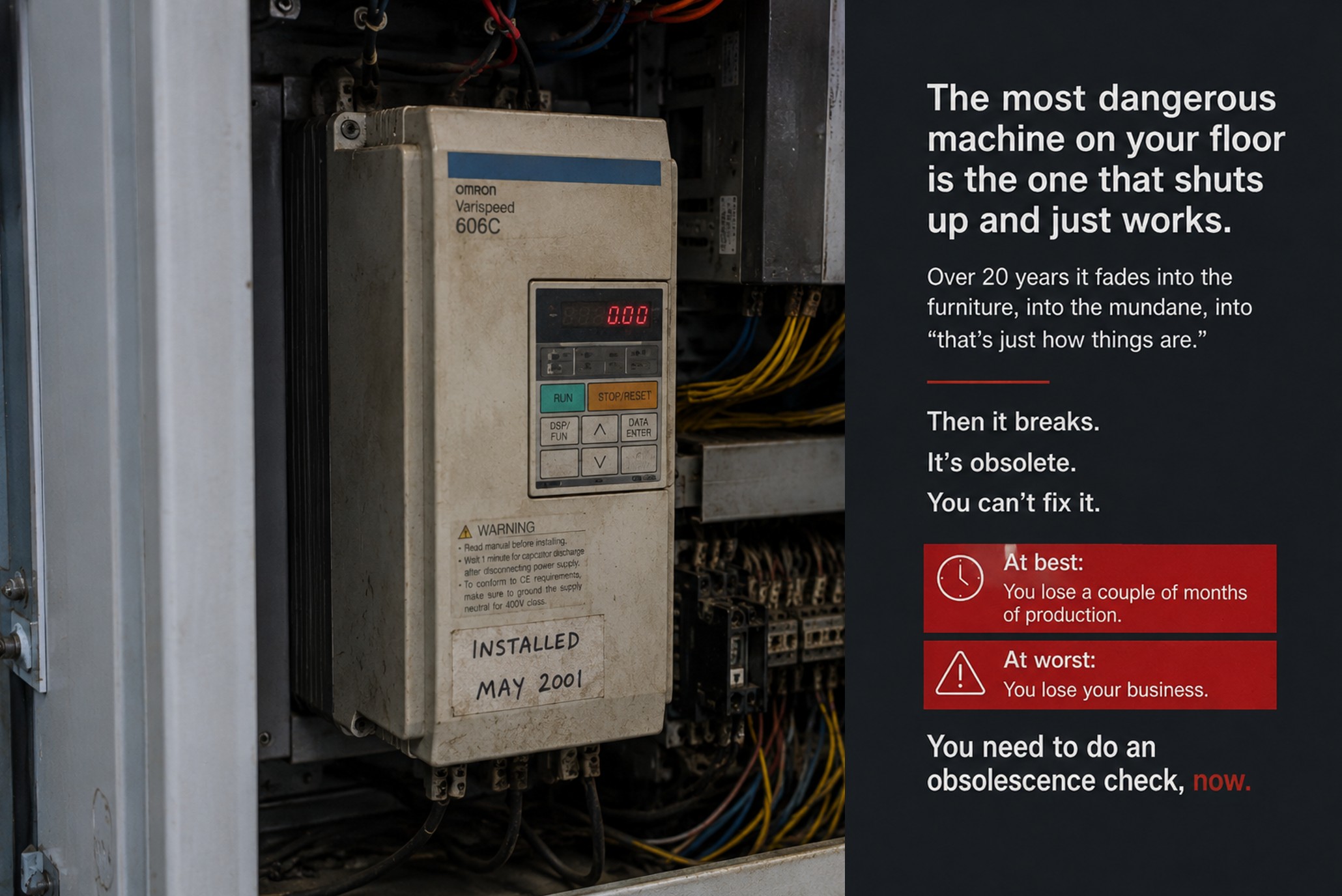
The most dangerous machine is the one that shuts up and just works, over 20 years it fades into the furniture and the mundane. When it breaks its obsolete you can’t fix it. At best you lose a couple months of production at worse you lose your business. You need to do an obsolescence check now!
Drama aside, this is a real problem, often a well-built machine just works – plodding along making you money and return on investment – until it breaks. Perhaps is the Drive, or the controller.“Not an issue, these things are very common” you tell yourself. They might have been common 20 years ago, today – not so much.
You call a supplier: “Do you perhaps stock a MinTingDong drive from the 18th century?” the supplier laughs, that laugh is all you need to hear to know you are going to have a bad day. Before you know it you have been passed around between suppliers and engineering firms in the hopes of finding a solution. In the end, you may find a replacement, a repair or a stop gap, how much did this actually cost you is difficulty to tell.
t really does not need to be this way. With one proactive step you could mitigate all these risks. The proactive step is a Obsolescence check!
t really does not need to be this way. With one proactive step you could mitigate all these risks. The proactive step is a Obsolescence check!
How the obsolescence scorecard works
Every machine is really just a collection of critical components with a use-by date nobody wrote down. The scorecard rates each one, then rolls it up into a single risk score for the whole machine.
Down the left side sit the critical components: the drive, the PLC, the HMI, the control card, the memory module, the power supply, whatever actually keeps the machine breathing. Across the top sits the thing that matters most when one of those fails: how hard is it going to be to get it working again.
We split that into four tiers.
> Tier 1, drop-in replacement. The component is available off the shelf, same part number or an exact modern equivalent. Order it today, fit it this week, nobody even notices.
> Tier 2, replaceable with existing components and a bit of work. No exact match anymore, but a modern equivalent exists. Expect some rewiring, reprogramming, or a panel modification. A few days of engineering, not a few months.
> Tier 3, replaceable, but operability is not guaranteed. You can find something that fits, refurbished, secondhand, or a workaround, but there's no promise it plays nicely with the rest of the system. Budget time for testing, and budget for it not working on the first try.
> Tier 4, obsolete, irreplaceable, OEM no longer exists. The manufacturer is gone, the part is gone, and the only path forward is a redesign or a full retrofit. This is the tier that closes production lines.
Score every critical component against its tier and you get an actual risk profile for the whole machine, instead of a gut feeling. A machine that's mostly Tier 1 and Tier 2 can keep plodding along in peace. A machine carrying even one Tier 4 component is running on borrowed time. Now you know it, instead of finding out the hard way when a supplier laughs at you down the phone.
That's only half the picture though. A component's tier tells you how hard it is to replace, but not what happens while you're waiting. For that you need two more things, and neither of them belongs on the same scale as the tier.
The first is criticality. Is the component Critical, meaning the machine stops without it, or Auxiliary, meaning production can limp on in some reduced or workaround state. The second is lead time. Not the number on the supplier's brochure, the honest one you get when you actually ask: how long from "we need this now" to "it's fitted and running."
Put those two next to the tier and the picture gets a lot sharper. A Tier 4 Auxiliary component is annoying, but you can live with it while you sort something out. A Tier 3 or 4 Critical component with a six month lead time is the one that should be keeping you up at night, and it's exactly the kind of thing that hides in plain sight for twenty years until the day it doesn't.
We didn't try to boil all of that down into one master score. A machine's risk isn't a single number, it's a short list: which components are both hard to replace and impossible to work around. Find that list, and you know exactly where to spend your time and budget.
Do your own check
Want to run this over your own equipment before it decides to fail on a Friday afternoon? Download the Obsolescence Scorecard below, print it, and work through it machine by machine. It won't stop things from breaking, but it will stop you from being surprised.